| RESULTS AND DISCUSSION |
| Soil Mapping |
| See Flooding and erosion assessment. |
| Relationship of soil properties with different land use/cover types |
Average infiltration rate measured in the field was found to be highest in the measurements taken from forest areas and lowest in areas of corn cultivation. Hydraulic conductivity values showed considerable variation on the different land use / cover types as well. The highest average hydraulic conductivity (61.93 cm/hr) was measured in soils from forest areas and the lowest (11.66 cm/hr) in corn fields. Average hydraulic conductivity of soils under grassland was 27.52 cm/hr. The figure below shows the variation of these properties on different land use/ cover types and how they relate to one another.
The low infiltration rate and hydraulic conductivity on corn fields could be an indication that the soils in these areas are degraded as a result of human interventions. The use of heavy machinery for ploughing the land could be responsible for making the soil compact and negatively influencing hydraulic conductivity leading to reduced infiltration rates. |
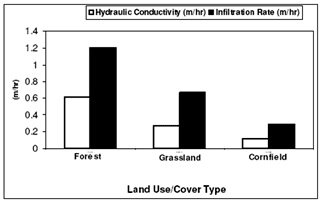 |
Figure 1 : Average Infiltration rate
and hydraulic conductivity
in different land use/cover types |
|
|
| Grassland areas also showed relatively lower values probably because most of these areas were previously used for agricultural purposes. The observations that were made in these areas were not entirely unforeseen and coincide with the findings of (Kunda, 2004). Forest soils showed higher values of hydraulic conductivity and infiltration rate. The reason for this could be that the soils in these areas are undisturbed and this has allowed them to maintain good soil structure and high porosity. |
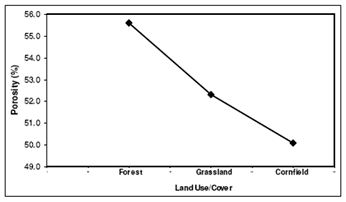
Analysis of soil porosity on different land use / cover types also showed a similar trend with the highest average porosity (56%) in forested areas and the lowest (50%) in corn fields. Bulk density, which is inversely related to soil porosity (figure 6-9), showed the highest values in corn fields with an average of 1.21 gm/cm3 and the lowest in forested areas with an average value of 1.04 gm/cm3 . The increase in bulk density and reduction in porosity on corn fields could be an indication that the soils in these areas are more compacted than the soil in forest or grassland areas due to the use of heavy machinery. Since porosity and infiltration rate are positively related soil properties , a reduction in soil porosity results in a reduction in infiltration rate. Reduced infiltration rates, bring about a reduction in the amount of rainwater that can infiltrate into the soil. This implies that more water will be available at the surface after a rainstorm resulting in increased rates of runoff. An increase in the rate of runoff increases the capability of running water to detach and carry soil particles bringing about further soil degradation problems.
|
 |
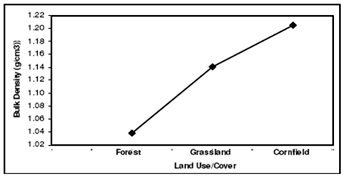 |
Figure 2 : Average soil porosity
in different land use / cover types |
Figure 3 : Average soil bulk density
in different land use / cover types |
|
| The results of the organic matter content in relation to land use/cover, was observed to be similar to the pattern shown by bulk density . It was highest on corn fields (2.1%) and gave a similar, lower value in the grassland and forest areas (1.6%). This was not unexpected and can be explained by management implementations such as the use of organic fertilizers in these areas. |
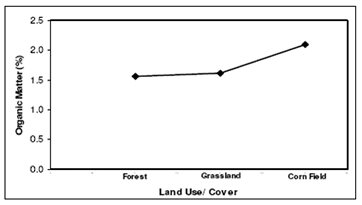 |
| Figure 4 : Average soil organic matter content in different land use/cover types |
|
| References |
 Kunda, F., 2004. Study of soil organic matter under different land uses in relation to land degradation : Nam Chun sub-watershed in Lom Sak, Thailand. MSc Thesis, International Institute for Geo-Information Science and Earth Observation, Enschede, 108 pp. Kunda, F., 2004. Study of soil organic matter under different land uses in relation to land degradation : Nam Chun sub-watershed in Lom Sak, Thailand. MSc Thesis, International Institute for Geo-Information Science and Earth Observation, Enschede, 108 pp. |
|