RAINFALL SIZE SCENARIOS
|
| To understand the runoff characteristics of the study area during extreme rainfall events on the downstream portion, large historical storms should be considered. However, the historical hourly rainfall recorded data was not available. Therefore, a synthetic storm was designed based on rainfall data of 6 September 2005 by multiplying with certain factor and comparing to the maximum daily rainfall at Lom Sak station in the period 1952 to 2002. This was used to predict the event reoccurrence (return period) using Gumbel extreme values method. All other setting parameters remain unchanged. Since the storm used is only hypothetical it is not possible to assess how far its results would reflect the real situation (Hessel, 2002). The hydrographs simulated at the outlet of the catchment were used for further analysis to assess the flood hazard in lowland area . The following multiplying factors were used to obtain hydrographs of predefined return periods: |
 The event with multiplying factor 1 ( 2 years return period): base simulation The event with multiplying factor 1 ( 2 years return period): base simulation
The event with multiplying factor 1.5 ( 5 years return period)
The event with multiplying factor 2.0 ( 10 years return period)
The event with multiplying factor 2.5 ( 20 years return period)
The event with multiplying factor 3.0 ( 50 years return period)
|
|
| The results show that the influence of land-use conditions on storm runoff generation depends greatly on the rainfall event characteristics. (See figure 1) |
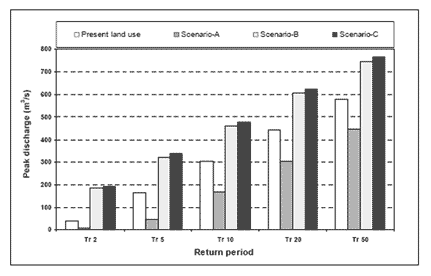 |
Figure 1 : Effect of different scenarios on peak discharge
with return period of 2, 5, 10, 20 and 50 years.
|
|
The prediction was very sensitive to storm size: a storm of one and a half size (multiplying factor 1.5) of the original storm produced 4 times the peak runoff from the original event (present situation). On scenario A (entire forest) also was affected by storms size. The reason for this is probably due to the fact that with increasing storm size infiltration becomes less important. However, the results showed decrease in the peak discharge and runoff amount in cases of high rainfall events therefore, the reducing effect of the catchment on the amount of runoff brought on by foresting the entire catchment could perhaps prevent the occurrence of disastrous floods downstream. |
| References |
| Hessel, R., 2002. Modelling soil erosion in small catchment on the Chinese Loess Plateau; Applying LISEM to extreme conditions, Utrecht University, Utrecht, 318 pp. |
|