| DIGITAL TERRAIN ANALYSIS |
| Slope gradient and STI were generated form DEM, so the quality of DEM is very important. DEM was generated from digital contour lines, which needed to be improved by detecting and reducing errors. The methods to detect and reduce errors were used to improve DEM before generating terrain parameters as follows |
| a) Detection and quantification of errors |
| It is important to first detect and reduce errors in the DEMs (Wise et al., 2000). Padi terraces are areas where all surrounding pixels show the same value Padi terraces are typical for closed contour lines and results obtained by linear interpolators, but can also appear when smoother interpolators are used. In a GIS, padi terraces can be detected using a neighbourhood operation and can be detected. |
| b) Reduction of errors |
| To improve the plausibility of the DEM, first step in improving the DEMs derived from the contour data is to account for features not shown by the contours such as break-lines indicating ridges or valley bottoms . This can be achieved by using automated detection of medial axes between the closed contour lines. First, the padi terraces need to be detected using Eq.(1) then the medial axes can be detected using a distance operation from the bulk contour data (Pilouk, 1992). The new elevation is assigned to the medial axes between the closed contours by adding or subtracting some threshold elevation value, e.g. standard deviation of the elevation values (Hengl, et al., 2003) |
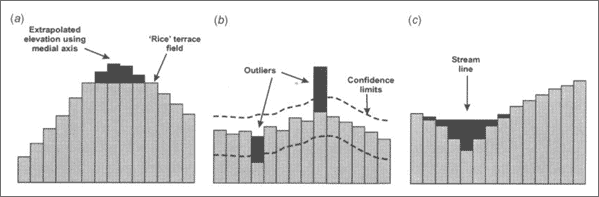 |
| Figure 1. Schematic examples of DEM filtering using cross-sections: a) reduction of padi terrace fields ; b) reduction of outliers and c) adjustment of the elevation using drainage lines. Blach-coloured strips indicate the change in elevation values. (Source : Hengl et al., 2003) |
|
|
| |