| SOIL EROSION ASSESSMENT |
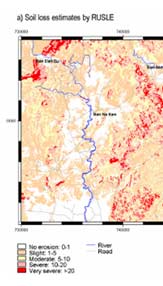
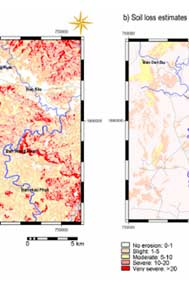
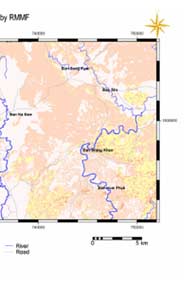
| From the results of researches it appeared that 2 erosion models namely RUSLE and RMMF, seem to be the most appropriate for Thailand. They can be applied without major constrains. RMMF can be made applicable to watershed level by incorporating flow accumulation derived from digital elevation data. But this must be validated using field data. Then only we can say which model is the most suitable one for Thailand situation since the results from the two models vary considerably (Figure 1). Even using one erosion model results can vary by changing some parameters (Table 1). Main problem is due to unavailability of field data for validating model results. Without soil loss data it is difficult to say which model gives results which are close to the real situation. In September 2003 Dhruba Shrestha, together with Ms. Suda Swutanakoon and Mr. Sunton Ratchadawong (LDD staff, regional office in Phitsanulok) visited erosion plots in Nam Nao, which is close to Namchun Watershed. Soil loss data from these plots would be very much useful in calibrating and validating model results. Shrestha suggested to improve the existing erosion plots and also suggested to add some more plots to cater for measuring soil losses under maize cultivation, the main crop in the area. Since the erosion plots were not in good condition suggestions were made to improve them during project meetings in Bangkok. Soil loss data still needs to be collected. |
|
Figure 1 : Results of two erosion models applied in
Lomsak–Lomkao area, Thailand (Shrestha et al., 2004) |
| |
|
| Landuse/cover |
Area (ha) |
Predicted soil loss (ton/ha/yr) |
| Using revised MMF |
Incorporating STI in revised MMF |
| Degraded Forest |
3539 |
4 |
2 |
| Grassland |
1243 |
2 |
1 |
| Orchard |
74 |
10 |
3 |
| Planted forest |
357 |
11 |
6 |
| Annual crop |
1444 |
19 |
15 |
|
| |
| Rulse |
| In Thailand Universal Soil Loss Equation (Wischmeier and Smith, 1965) is still extensively used. The revised USLE (Renard et al., 1991) may be better alternative than the original model. (Yazidhi, 2003)) showed that the model can be applied in Thailand situation. The revised universal soil loss equation (RUSLE) is an empirical model, modified from the USLE (Renard et al., 1997). It estimates sheet and rill erosion as a function of 6 major factors. It maintains the basic structure of USLE and computes annual soil loss in t/ha/yr as follows: |
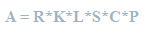 |
Where,
R: rainfall-runoff erosivity factor,
K : soil erodibility factor,
L: slope length factor,
S: slope steepness factor,
C: cover-management factor,
P: supporting practices factor. |
| |
| RMMF |
| MMF model predicts annual soil loss from field-sized area (Morgan et al., 1984). The MMF model is simple, flexible and it provides a stronger physical base than USLE. In the revised MMF model (Morgan, 2001) soil particle detachment by raindrop impact takes into account plant canopy height and leaf drainage. Also detachment by surface overland flow is added. |
| The RMMF was developed to cater for difficulties realized in collecting data on rooting depth and as a result of improvements in data availability especially soil detachability since the original MMF model (Morgan, 2001). In the revised version, effective hydrological depth is considered instead of rooting depth as in the original version. New detachability values have also been provided as an improvement from the soil detachability index of the original version, while the revised model also caters for leaf drainage, ability of runoff to detach as well as transport by rainfall. The model separates the soil erosion process into two phases i.e. the water and sediment phase. In this way, the model recognizes that erosion can either be transport or detachment limited. |
| |
| Estimation of rainfall energy |
| The energy of rainfall is calculated by taking into account the way rainfall is partitioned during interception and the energy of the leaf drainage. The model takes the annual rainfall total (R; mm) and computes the proportion that reaches the ground surface after allowing for rainfall interception (A; 0-1). R and A are multiplied together to derive effective rainfall (ER) as follows. |
 |
| The model then distributes effective rainfall into rainfall that reaches the ground without interception, and rainfall that reaches later as leaf drainage (LD) after being intercepted by plant canopy (CC; %) using equations below. |
 |
| Leaf drainage is then used to calculate direct through fall of effective rainfall (DT) as in equation below. |
 |
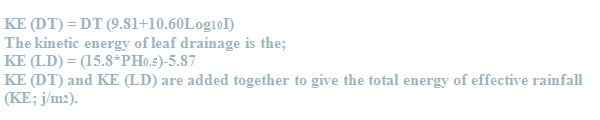
| Kinetic energy is then calculated for effective rainfall of leaf drainage (KE (LD); j/m2) and effective rainfall of direct through fall (KE (DT); j/m2). KE (LD) and KE (DT) are a function of plant height (PH) and intensity (I) respectively. Kinetic energy of direct through fall is computed as follows. |
 |
| |
| Estimation of runoff |
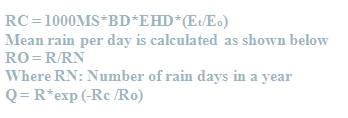
| Annual runoff (Q) is calculated using a relational equation between annual rainfall (R; mm), mean rainy day (RO; mm) and moisture storage capacity. Soil moisture storage capacity (RC; mm) is in turn a function of bulk density (BD; mg/m3), soil moisture content at field capacity (MS; %ww), effective hydrological depth (EHD; m), and ratio of actual to potential evapotranspiration (ET/EO). The equations below show the computation of soil moisture storage capacity; |
 |
| |
| Estimation of soil particle detachment by raindrop |
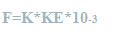
| Soil particle detachment by raindrop impact (F; kg/m2) is calculated as a function of kinetic energy (KE; j/m2) and soil erodibility (K; g/j) as follows. |
 |
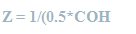
| The equation used to compute soil particle detachment by runoff (H; kg/m2) is based on experimental work of Quansah (1982) as cited by Morgan (2001) and is calculated as a function of runoff (Q: mm), slope steepness (S; 0), soil resistance (Z) and ground cover (GC; %). Soil resistance is in turn dependent on surface cohesion (COH; kpa). The model assumes that soil particle detachment by runoff only occurs where soil is not protected by ground cover. The equations below show the computation of soil resistance as; |
 |
| And of runoff detachment as; |
 |
| Total particle detachment (D; Kg/m2) is finally computed as a sum of soil particle detachment by runoff and soil particle detachment by raindrop impact as shown below. |
 |
| Transport capacity of runoff (TC; kg/m2) is estimated as a function of runoff (Q) surface cover factor (C), runoff and slope gradient (0) as follows. |
 |
| TC is the compared with D and the lower of the two is taken as the annual soil loss (kg/m2). |