“Landslides are one of the normal landscape building processes in mountainous areas. They become a problem when they interfere with human activity”(van Westen, Soeters et al. 1993).
The problem of landslides is of essential importance to a large number of countries not only because of the extensive damages, which are caused from time to time, but also because of the tragic loss of human life, which ensues (Ercanoglu, Gokceoglu et al. 2003).
The term landslides refers to “the movement of a mass of rock, debris or earth down a slope” (Cruden and Varnes 1996). Soil is divided into : debris and earth. The term Debris refers to material which contains a significant proportion of coarse material 20 to 80 percent of the particles are larger than 2mm and the remainder of the particles are less than 2 mm. Earth describes material in which 80 percent or more of the particles are smaller than 2mm.These movements are classified according certain criteria (Table 1.). The first criterion is the type of movement and the second is the type of material. The types of movement include falls, topples, slides, spreads, flows and a complex type, which is a combination of two or more of the other types of movement mentioned earlier. The type of material is divided into two main classes: rock and soil (Varnes 1978; Cruden and Varnes 1996).
Table 1 : Classification of Slope Movements (Varnes 1978)
TYPE OF MOVEMENT
TYPE OF MATERIAL
BEDROCK
SOILS
Predominantly coarse
Predominantly fine
Falls
Rock Fall
Debris Fall
Earth Fall
Valley (Va)
Flood Plain
Alluvial deposits
Levee - Overflow complex
SLIDES
ROTATIONAL
FEW UNITS
Rock slump
Debris slump
Earth slump
TRANSKATIONAL
MANY UNITS
Rock block slide
Debris block slide
Earth block slide
Rock slide
Debris slide
Earth slide
LATERAL SPREADS
Rock Spread
Debris Spread
Earth Spread
FLOWS
Rock flow
(Deep creep)
Debris flow Earth Flow
(Soil creep)
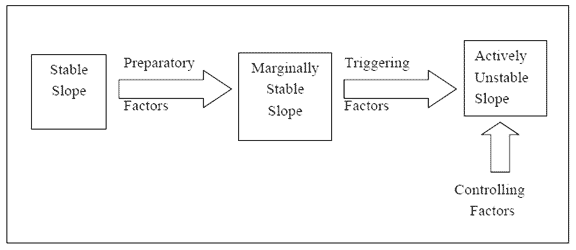
Landslides have several causes or causal factors and these include geological, morphological, physical and human factors. These factors are also referred to as destabilising (Crozier 1986; Wieczorek 1996). These factors can be classified into three main groups: preparatory, triggering and controlling (perpetuating) factors(Crozier 1986). Preparatory factors – factors (like rock type, soil texture etc.,) that make the slope susceptible to movement without actually initiating it and thereby tending to place the slope in a marginally stable state. Triggering factors like earthquakes, intense rainfall, volcanic eruption etc., initiate the movement and shift the slope from marginally stable to an actively unstable state. The controlling or perpetuating factors (like topography, etc.,) determine the condition of movement as it takes place. These factors control the form, rate and duration of mass movement.
Figure 1 : Relationship between the causal factors and Slope stability Adopted From (Crozier 1986).
Landslide hazard study was carried out in Wang Chin, Phrae province. So far only one research had been done for landslide hazard study. For landslide mapping, ortho-photos, image classification of ASTER data, and model were applied to assess hazard. For modeling landslides, various methods can be applied but weights of evidence approach seems to be more applicable. It is a quantitative method which combines evidence in support of a hypothesis. The step-by-step approach, or factor analysis, used to prepare a landslide hazard map had been described. (van Westen et al., 2003):
Objectives
The main objective of this study was to investigate whether analysis of factors causing landslides in one area (Wang Chin in Northern Thailand), where landslides have been caused by a major rainfall event, can be used for building a model to assess landslide susceptibility in another area which has not had recent landslides . A further objective was to evaluate the use of digital image processing for landslide mapping.
References
Crozier, M. J. (1986). Landslides: Causes, Consequences and Environment. London, Croom Helm.
Cruden, D. M. and D. J. Varnes (1996). Landslide types and Processes. Landslides: Investigation and Mitigation. A. K. Turner and R. L. Schuster. Washington, D.C, Transportation Research Board National Research Council. Special Report 247: 36 - 75.
Ercanoglu, M., C. Gokceoglu, et al. (2003). "Landslide Susceptibility Zoning of North Yenice (NW Turkey) by Multivariate Statistical Techniques." Natural Hazards 00(00): 1 - 23.
van Westen, C. J., R. Soeters, et al. (1993). "Geographic Information Systems as applied to landslide hazard zonation." Mapping Awareness & GIS in Europe 7(5): 9-13.
Varnes, D. J. (1978). Slope Movement Types and Processes. Washington D.C, Transport Research Board National Academy of Sciences.
Wieczorek, G. F. (1996). Landslide Triggering Mechanisms. Landslides Investigation and Mitigation. A. K. Turner and R. L. Schuster. Washington D.C, Transportation Research Board National Academcy of Sciences. Special Report 247: 76-90.
Development of Methodologies for
Land Degradation Assessment Applied to
Land Use Planning in Thailand





 Preparatory factors – factors (like rock type, soil texture etc.,) that make the slope susceptible to movement without actually initiating it and thereby tending to place the slope in a marginally stable state.