| GENERATION OF SCENARIOS |
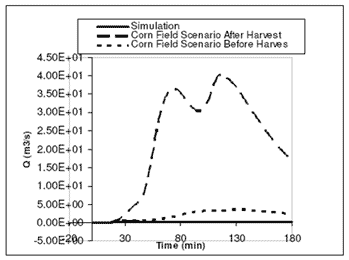
| Scenarios were generated to assess the effects of major changes in catchment management practices or cases of increasing rainfall amounts on the rate of the predicted surface runoff. If the model accurately estimates the runoff pattern, these scenarios will be very useful in decision making processes on catchment management. These assessments could aid in answering questions such as |
 What are the effects of implementing agricultural practices throughout the watershed? What are the effects of implementing agricultural practices throughout the watershed? |
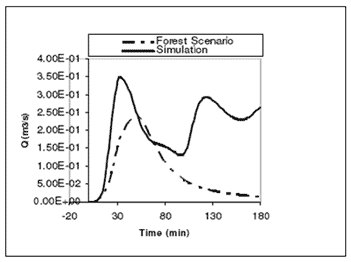
| What pattern will be observed in surface runoff if the land use/ cover of the entire catchment is converted to forest? |
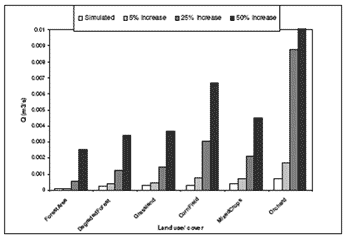
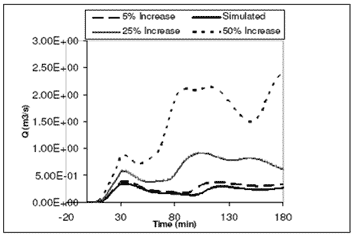
| How does the catchment, with present land use/ cover, respond to rainfall events of different magnitudes? |
|
| Such information can be used to implement changes in an effort at reducing the rate of surface runoff in the long run diminishing problems of land degradation in the catchment and controlling flooding hazard in the lowlands. Scenario studies help to answer what if questions that may be impractical to realize on the ground but that can easily be simulated in a model. Three different scenario studies were done in response to the questions above and the results are discussed in the following sections. |
Effects of Changing Land Use/Cover
to Corn Cultivation in the Watershed |
Effects of changing the land use/cover
to Forest in the Watershed |
 |
 |
| Figure 1 : Hydrograph showing the base simulation at the river Huai Nam Chun and the changes incurred by the scenarios |
Figure 2 : Base simulation results compared
with forest scenario |
| Effects of different rainfall amounts |
 |
 |
| Figure 3 : showing the effects on predicted runoff rates with different rainfall events |
Figure 4 : Hydrographs of base simulation and predictions of different rainfall amounts |
|