| LANDSLIDE SUSCEPTIBILITY MAPS FROM THE THREE SCENATIOS (MODELS) |
| Landslide susceptibility is defined by (Hansen 1984; Cruden and Varnes 1996), as the proneness of the terrain to produce slope failures. Susceptibility is usually expressed in a cartographic way as discussed by (Brabb 1984). A landslide susceptibility map depicts areas likely to have landslides in the future by correlating some of the principal factors that contribute to landsliding with the past distribution of slope failures (Brabb 1984). The landslide susceptibility maps are a spatial representation of the degree to which an area is prone to landslides. These maps are classified into classes ranging from Low to High hazard zones depending on the factors under consideration. In this study the landslide susceptibility maps were classified into three classes : |
| Low Susceptibility : indicated as the low hazard class (colour code-green): Areas for which the combination of factors is less likely to adversely affect the stability provided that the existing ground conditions are not radically altered to facilitate site development. |
| Moderate Susceptibility : indicated as the moderate hazard class (colour code- yellow): Areas for which the combination of factors may adversely influence slope stability. |
| High Susceptibility : indicated as the high hazard class (colour code- red): Areas for which existing ground conditions are likely to create serious landslide problems. In general, these areas are unsuitable for site development. The cost of carrying out standard geologic geotechnical investigations and remedial/preventive work for slope stabilization may be very high. Therefore, it is best to avoid these slopes as far as possible except for the most essential use. A thorough ground investigation report by competent persons should be required before any site development is undertaken. |
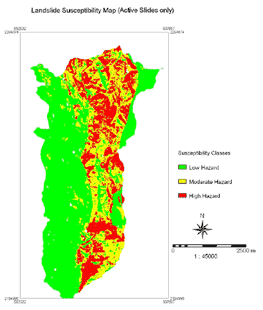
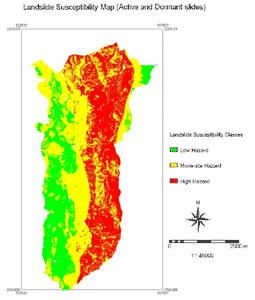
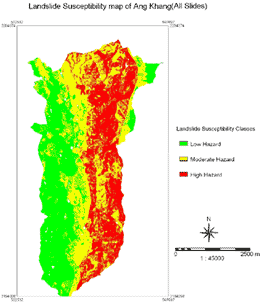
| Since three models were used, three final weight maps were produced. Using the slicing operation in ILWIS 3.3 version, each of the final weight maps was classified into three hazard classes. Classification was based on histogram information for each of the final weight maps generated from each of the three models. The best scenario was selected. The result was the landslide susceptibility map for each of the models as indicated in Figures 1 to 3. |
 |
 |
| Figure 1 : Landslide susceptibility map (Active Slides Only) |
Figure 2 : Landslide susceptibility map (Active and Dormant Slides) |
 |
|
| Figure 3 : Landslide susceptibility map (All Slides) |
|
|
| |
| Validation of the results |
3 scenario were weighted namely:
Scenario 1: Using a Landslides map indicating Active Landslides only
Scenario 2: Using Active& Dormant Slides and Scenario
Scenario 3: Using All Slides. |
| In order to evaluate the performance of the model, scenario 2 was selected. This because it provided better results compared to scenario 1 and 3. To test the prediction rate, the weighted map from scenario 2 was crossed with the landslide map from the field (2005). The results of the cross are presented in Table 1. |
| Theme Class |
Active Slides |
Active & Dormant Slides |
All Slides |
| Land Cover |
WFINAL |
WFINAL |
WFINAL |
| Agriculture |
-1.5918 |
-2.6409 |
-2.6409 |
| Bare Land |
0.8925 |
-0.3505 |
-0.3505 |
| Built-up Area |
-3.1060 |
-4.2051 |
-4.2051 |
| Degraded Forest |
1.3391 |
0.2922 |
0.2922 |
| Dense Forest |
-1.8258 |
0.1367 |
0.1367 |
| Open Forest |
-0.9794 |
-0.3428 |
-0.3428 |
| Distance to Roads |
|
| 0 - 10m |
-0.4960 |
-1.1455 |
-1.1455 |
| 10 - 20m |
0.2696 |
-0.0290 |
-0.0290 |
| 20 - 30m |
0.3662 |
0.4586 |
0.4586 |
| 30 - 50m |
-0.0221 |
-0.0204 |
-0.0204 |
| 50 - 500m |
-1.1754 |
-0.9981 |
-0.9981 |
| 500 - 1000m |
-0.6124 |
-0.0973 |
--0.0973 |
|
| The results in Table 6.9 indicate that 84% of the observed landslides are located in the area predicted to have the highest occurrence of landslides. Since more than 70% of the active landslides are accounted for, then it can be said that the model was a good prediction for the occurrence of landslides in Ang Khang. The results in the table 2 indicate that only 45.% of the area is highly susceptible to landslides which is less than half of the total area of Ang Khang. This is expected since about half of the area, the Western part if dominated by Limestone which is pervious and therefore not susceptible to landslides. |
| Susceptibility Class |
Percentage of active slides in the class(%) |
Percentage of total Area % |
| High Hazard |
84 |
45 |
| Moderate Hazard |
14.1 |
17 |
| Low Hazard |
1.9 |
38 |
|
| References |
 Brabb, E. E. (1984). Innovative approaches to landslide hazard and risk mapping. Toronto, Canada, Canadian Geotechnical Society. Brabb, E. E. (1984). Innovative approaches to landslide hazard and risk mapping. Toronto, Canada, Canadian Geotechnical Society. |
| Cruden, D. M. and D. J. Varnes (1996). Landslide types and Processes. Landslides: Investigation and Mitigation. A. K. Turner and R. L. Schuster. Washington, D.C, Transportation Research Board National Research Council. Special Report 247: 36 - 75. |
| Hansen, A. (1984). Landslide Hazard Analysis. Slope Instability. D. Brunsden and D. B. Prior. New York, John Wiley & Sons: 523 - 592. |
|