| RELATIONSHIP BETWEEN SOIL PROPERTIES |
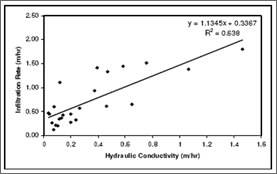
The relationship between the different soil properties was assessed using a regression analysis. The level of the relationship between all cases assessed, was found to be statistically significant (P<0.05). Figure 6-8 shows the relationship between hydraulic conductivity and infiltration rate. The statistical significance of the relationship revealed a positive linear correlation with r=0.798 and R2 =0.638. 64% of the variation in infiltration rate is therefore explained by hydraulic conductivity in line with the physical nature of soil and its properties (Hillel, 1980). Land use/cover changes that bring about a reduction in soil hydraulic conductivity therefore also result in reduced infiltration rates.
|
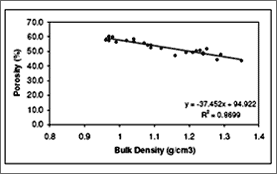
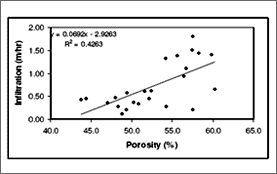
Soil bulk density and porosity showed a strong negative correlation with r=-0.933 and R2 = 0.869 as indicted in figure 6-9. The two soil properties were found to be inversely associated. As bulk density of the soil increases as a result of management practices in the watershed, the porosity of the soil reduces. A reduction in soil porosity subsequently brings about a decline in hydraulic conductivity and infiltration rate of the soil as indicated in figures 6-10 and 6-11 respectively.
|
 |
|
 |
| Figure 1 : The relationship between hydraulic conductivity and infiltration rate |
Figure 2 : The relationship between soil porosity and bulk density |
|
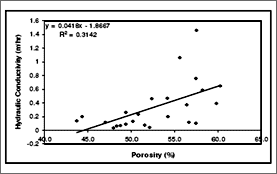
| The relationship between soil porosity and hydraulic conductivity was significant (P<0.05). However, the results show a weak positive relationship (r=0.56 and R2 =0.314) between the two properties. The results obtained could have shown a stronger correlation with more number of observations. High porosity therefore promotes the passage of water into the soil inline with soil hydraulic properties. Porous soils accordingly facilitate infiltration of rain water into the soil reducing the amount of water that could be available for surface runoff in the long run. |
 |
|
 |
| Figure 3 : The relationship between soil porosity and hydraulic conductivity |
Figure 4 : The relationship between soil porosity and infiltration rate |
|
The student t-test analysis was conducted to find out weather the soil properties showed significant difference with respect to slope position. Except for organic matter content and hydraulic conductivity of samples taken from corn fields, the remaining did not exhibit significant differences (P>0.05). The average saturated hydraulic conductivity of soils under maize cultivation analysed from samples taken in middle slope areas, had higher values with an average of 17cm/hr. Samples taken from the summit areas on the other hand showed very low values with an average of 6.7 cm/hr. This could be attributed to higher water erosion taking place in these areas owing to their slope position. The cultivation of maize in these areas further promotes the degradation process of the already susceptible soils through the use of heavy machinery. This leads to a significant decline in the hydraulic conductivity of the soils in these areas. Moreover, average infiltration rate was also seen to be lowest in measurements taken from cornfields in summit areas which further support the findings. Areas of corn cultivation could therefore be resulting in increased surface runoff generation due to management practices which have reduced the infiltration capacity of the soils in these areas. As such, these areas could be target locations for further investigations in order to implement measures to improve the quality of the soils in
these areas.
|