|
|
| |
1.
Small-Scale Water Resources Development Project |
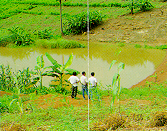
Small-scale water resources
are established with water distribution system for cultivated
areas all over the country.
|
 |
|
| Objectives: |
|
To make water
conservation outside the irrigation area more effective while
keeping the soil moisture. Farmers will have sufficient water
for utility and agriculture. |
|
To make the best use of
agricultural land by effective management of land and water
resources for higher productivity through self-reliance. |
|
| |
| Operation
sites: |
|
The rainfed
area all over the country |
|
|
|
| |
| Scope
of work: |
|
Make a survey,
structural design, and built 1,500 small- scale water resources.
|
|
Develop 125 locations
of agricultural land at the total of 250,000 rai to be supplied
with these water resources. |
|
Inform the farmers the
right way to use water for agriculture and make it implementable
for their living. |
|
| |
| Budget
and duration: |
|
5 years (1997-2001) |
|
|
| |
7,212.12 million baht |
|
|
|
| |
2. Farm Ponds Development Project |
| |
| Small
ponds are planned on each farm to help supply enough water for agriculture
in the dry season. |
| |
| Objectives: |
|
To supply
enough water both for agriculture and for utility in the dry
season. |
|
To conserve soil and water
as well as helping reduce soil erosion. |
|
To increase income of
the farmers and make a better living standard. |
|
| |
| Operation
sites: |
|
All over the
country |
|
|
| |
|
|
| |
| Scope
of work: |
|
Arrange to
build 1,260 cu.m capacity ponds at252,200 locations all over
the country. The selected sites have to be in the land development
villages and the one having water shortages, where it is could
accommodate 5-15 ponds in each area. Construction will be done
by private contraction. |
|
|
| |
|
|
| |
| Budget
and duration: |
|
5 years (1997-2001) |
|
|
| |
5,040 million baht. |
|
|
|
| |
3. Land Development on Highland Community
Project (Phase 2) |
| |
There are total highland
area of 96.1 million rai spreading over different parts
of Thailand. Natural resources and environment in the form
of watershed forest in these area are mostly destroyed.
The target area must be identified and planned for development
and conservation.
|
|
|
| Objectives: |
|
Adequate land
use zoning is needed to conserve the environment and natural
resources. |
|
To establish soil and
water conservation system, including small waterways and check
dams on the agricultural land. |
| |
|
|
| |
| Operation
sites: |
|
Highland area
in 34 provinces (14 northern,5 central, and 15 southern ) |
|
|
| |
|
|
| |
| Scope
of work: |
1. |
Make a feasibility
plan on 14 southern provinces. |
2. |
Develop highland
area in the 14 northern, 5 central, and 15 southern provinces
by |
| |
- |
classify and segregate
agricultural and residential area from the forest land which
come up to 408,000 rai for usage. |
| |
- |
make a land use planning
of 408,000 rai for agriculture. |
| |
- |
establish soil and water
conservation system on 36,000 rai. |
| |
- |
plant economic crops on
75,000 rai. |
| |
- |
procurement for140 ton
of cover crops seed and 50 million stalk of vetiver grass |
| |
- |
training and
extension services |
|
| |
| Budget
and duration: |
|
5 years (1997-
2001) |
|
|
| |
872.61 million baht |
|
|
|
| |
4. Coastal Resources Management Project |
| |
| Bio-diversity
in the coastal land area is the most important resources for economy,
society, nature, and environment. Careful management of coastal resource
is necessary to keep ecological balance and make the effective use
of natural resources. |
| |
| Objectives: |
|
To indicate
the distinct scope of coastal land management. |
|
To make sure that the
coastal land is used to its full potential and study its impact
on other resources. |
|
Having a planning scheme
on the management of coastal land all over the country. Set
the priority of the problems to be solved and the implementation
steps. |
|
| |
| Operation
sites: |
|
At the 25
coastal provinces |
|
|
|
|
|
| |
| Scope
of work: |
|
Establish
the region of coastal land and area for marine shrimp aquaculture
in 25 provinces, set up an information system on coastal resources. |
|
Arrange for the coastal
resources management master plan for 9 provinces (province level)
and potential land use plan for 15 provinces and 75 districts
(district level). |
|
Follow up and report on
the changes in the use of coastal land in 24 provinces (except
Bangkok). |
|
Set up 5 projects of specific
coastal land development. |
|
| |
| Budget
and duration: |
|
5 years (1997-2001) |
|
|
|
104.55 million baht |
|
|
|
|
5. Saline Soil Development Project (Phase 2) |
| |
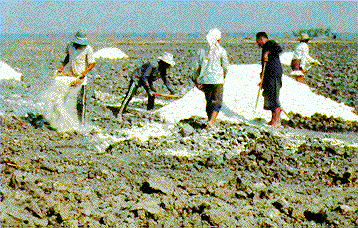
| The
problem of saline soil is increasingly severe causing the loss of
the farmers' income and fertile land. There are several factors contributing
to this widespread of soil salinity, e.g., salt farming, building
reservoir on saline area, deforestation on saline slope land. In the
northeastern part of Thailand there are a total of 17.8 million rai
of saline soil spreading over 17 provinces. They are classified as
12.6 million rai of low saline soil, 3.7 million rai of moderate saline
soil, 1.5 million rai of extreme saline soil, as well as another 19.4
million rai of potential spreading saline soil. Development to increase
agricultural productivity will be made on low and moderate saline
soil while demonstration farming will be set as a model on extreme
saline soil type. As for the potential spreading area information
will be provided to prevent its further widespreading. |
| |
| Objectives: |
|
To increase
the farmers' income in the low and moderate saline soil area. |
|
To prevent the further
widespread of saline soil. |
|
To improve the saline
soil for cultivation. |
|
Maintain the environmental
balance in the saline soil area. |
|
| |
| Operation
sites: |
|
Saline soil
area in the northeastern part of Thailand |
|
|
|
|
|
| |
| Scope
of work: |
|
5
million rai of target area of low and moderate saline soil |
|
|
Set up 30,000 rai of demonstration
paddy field model. |
| |
|
Promote cultivation of
soil improvement plants (African sesbania ) on 36,000 rai. |
| |
|
Improve soil fertility
to increase rice production in 900,000 rai. |
| |
|
Produce 1,980 ton of soil
improvement seeds (African sesbania) and purchase another 7,000
ton of the same kind of seeds. |
| |
|
Increase the improvement
of saline soil area to 300,000 rai. |
| |
50,000
rai of target area of extreme saline soil |
| |
|
Demonstrate
cultivation of salt-tolerant plants on 4,000 rai. |
| |
|
Feasibility study, survey,
design, and construct water control system for project of extreme
saline soil improvement. |
| |
|
Continue maintenance of
demonstration plot for another year. |
| |
Prevention
of further widespread of saline soil, target area 1.25 million
rai |
| |
|
Draw up the map (scale
1:50,000) for 2,500,000 rai to indicate the cultivation area
of fruit trees, trees, to prevent the spread of soil salinity. |
| |
|
Demonstrate reforestation
to prevent spreading of saline soil on 3,000 rai. |
| |
|
Plant 9,600,000 bags of
salt tolerant grass , and plant 500,000 seedling of salt tolerant
tree. |
|
| |
| Budget
and duration: |
|
5 years (1997-2001) |
|
|
|
1,863.13 million baht |
|
|
|
| |
6. Tung Kula Rong Hai Development Project (Phase 4) |
| |
| Tung
Kula Rong Hai is considered to be one of the most unproductive area
in Thailand. The total area of 2.1 million rai covers 5 provinces
in the northeast: Roi-et, Surin, Sri Saket, Maha Sarakam, and Yasothon.
Some parts of the area are sandy, some are saline soil while the other
are acid sulfate soil. Water supply is out of control, too little
in the early cultivation time but flooded at the end of the season.
Drought occupies the area in the dry season. Soil and water conservation,
and irrigation system have been set up in the area for paddy rice
improvement which cover 488,528 rai. The system helps increasing yield,
The alternative production of mixed field crops and fruit trees is
feasible. The program has to be extended to cover the whole area. |
| |
|
| |
| |
| Objectives: |
|
Land resource
development is proceeded to increase the productive potential
while soil quality is improved to attain better crop yield. |
|
|
|
|
|
| |
| Operation
sites: |
|
5 provinces
in the northeast : Roi-et, Surin, Sri Saket, Maha Salakam, and
Yasothon, covering area of 2.1 million rai. |
|
|
|
|
|
| |
| Scope
of work: |
1. |
Demonstration
of land development at 1,000 rai per year which amounts to 5,000
rai in 5 years. |
2. |
Survey, design, and construction
of soil and water |
3. |
Conservation–irrigation
system will be performed to improve 400,000 rai of paddy field. |
4. |
Shallow ponds will be
built at the total of 1,000 ponds in 5 years. |
5. |
Training program for farmers
is included. |
|
| |
| Budget
and duration: |
|
5 years (1997-2001) |
|
|
|
1,048.28 million baht. |
|
|
|
| |
7. Soil and Fertilizer Management Project |
| |
| According
to the survey made all over the country, 3.0 million rai of landis
misused while 191 million rai is unfertilized soil with low organic
matters. Soil development is urgently needed to improve the agricultural
productive land. However, farmers do not have proper techniques or
knowledge to select and cultivate appropriate plants for the soil
types. Type of soil itself could also contribute to the problem. Soil
in some southern part is peat soil and acidity caused by the sea water.
This soil cannot be used for cultivation and need proper management. |
| |
| Objectives: |
|
The misuse of land could
be solved by providing the correct information on how to select
suitable plants for the specific type of land as well as effective
use of fertilizer. Simple management procedure is needed to
help farmers increase their productivity and enable self-operation. |
|
Farmers should
know how to improve the soil with organic materials like decomposed
fertilizer or chopped plants or green manure. |
|
To find the suitable crops
for cultivation and feasible use of fertilizer. |
|
Improve the quality of
acid soil and saline soil for cultivation. |
|
| |
| Operation
sites: |
| |
General information on
soil development is provided all over the country. Emphasis
is made at specific target areas. |
|
|
|
|
|
| |
| Scope
of work: |
1. |
Land use according
to its potential |
|
1. |
Mapping of
land use in accordance with its potential at district level
using the scale of 1:25,000 for 35 districts. |
|
2. |
Set up demonstration of
effective farm management in 35 districts 1,050 rai. |
|
3. |
Training 5,250 farmer
leaders and governmental personnel. |
|
4. |
Public relation and extension
at 35 districts. |
2. |
Improvement
of soil with organic matters |
|
1. |
Construction 12 warehouses
for seeds of green manure plants. |
|
2. |
Produce and supply 20,900
ton of seeds.Supply 1,300,000 sets of catalyst for making decomposed
fertilizer. |
|
3. |
Demonstrate/promote the
use of green manure 85,000 /4,050,000 rai. |
|
4. |
Demonstrate/promote production
of decomposed fertilizer 47,000/1,175,000 ton. |
3. |
Academic
development on soil and fertilizer |
|
1. |
Give land-management advice
at the village level on grouping of soil for 19,560 villages. |
|
2. |
Give land-management advice
at individual farm level land development unit for 3,240 villages. |
|
3. |
Give soil analysis services
in the field andprovide land management advice to farmers using
soil analysis mobile unit for 282,000 samples. |
|
4. |
Detail soil analysis,
using advanced technical apparatus and advice (laboratory) 50,000
samples. |
|
5. |
Training 65,000 volunteer
soil doctors and retired substitute soil doctors, and distribute
65,000 copies of protocol booklets. |
|
6. |
Set up 12 soil analysis
laboratories. |
4. |
Acid
soil and saline soil development in the south. |
| |
1. |
Soil survey, planning
management zone of acid and saline soil at 10 provinces. |
| |
2. |
Survey, design for construction
of water controller system for 14 sites. |
| |
3. |
Set up 11,200 rai of acid
soil development for demonstration. |
| |
4. |
Provide soil improvement
materials and seeds for 250,000 rai |
| |
5. |
Supply rice seeds and
fruit tree stalks for demonstration 200 ton/240,000 stalks. |
| |
6. |
Public relation and extension
on the above subjects at 14 provinces. |
|
| |
| Budget
and duration: |
|
5 years (1997-2001) |
|
|
|
2,363.74 million baht |
|
|
|
| |
8. Acid Soil Development Project |
| |
| There are 5.5 million
rai of acid soil in 20 provinces of central and eastern Thailand.
Almost half of this land is considered extremely acid and unfertile. |
|
|
| |
| In
1975, Land Development Department has launched a program to help improving
these acid soil. 900,000 cu.m of marl lime is distributed to 27,000
farmers to use on 733,335 rai of acid soil area. Rice yield was increased
from 10 to 15-20 tung/rai which contributed to the increase of income
in the average of 600-800 baht/rai. However, there is 1.5 million
rai more of acid soil to be developed. A 5-year plan to provide enough
marl lime is needed. |
| |
| Objectives: |
|
Acid soil development
program through procedure demonstration, advice, and promotion
is established. The aim is to increase not only the crop yield
but also the possibility of using the land for agriculture. |
|
|
|
|
|
| |
| Operation
sites: |
|
The project will be established
at the 19 following provinces : Angthong, Suphan Buri, Nakhon
Pathom, Nonthaburi, Samut Sakhon, Petchaburi, Ratchaburi, Prachuap
Khiri Khan, Pathum Thani, Ayutthaya, Saraburi,Nakhon Nayok,
Prachin Buri, Samut Prakarn, Chon Buri, Chachoengsao, Rayong,
Trad. |
|
|
|
|
|
| |
| Scope
of work: |
1. |
To improve 775,000 rai
of acid soil for crop production by supplying 775,000 cu.m of
marl lime. |
2. |
Construction
of water controller system for 5,000 rai . |
3. |
Mapping on acid soil (1:50,000)
for 12 provinces. |
4. |
Feasibility study of changing
rice paddy to fruit production in 8 provinces. |
|
| |
| Budget
and duration: |
|
5 years (1997-2001) |
|
|
|
447 million baht |
|
|
|
| |
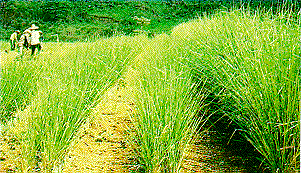
9. Royal Development and Usage of Vetiver Grass Project |
| |
| As
much as 134 million rai of land all over the country is severely eroded.
His Majesty the King has realized this great problem and suggested
the use of vetiver grass to help soil and water conservation. This
type of grass could be easily cultivated by farmers. It needs no complicate
technology to maintain and very economic to use. Land Development
Department has collected and distributed the information on vetiver
grass researches to farmers and governmental personnel. Strains of
vetiver grass are selected and propagated for farmers and working
units to use. |
| |
|
| |
| Objectives: |
|
To conserve water and
land from soil erosion as well as maintain the balance of environment
according to His Majesty the King's suggestion. |
|
|
|
|
|
| |
| Operation
sites: |
|
All over the country |
|
|
|
|
|
| |
| Scope
of work: |
|
Researches on selecting
the appropriate strains of vetiver grass to grow at different
parts of the country. |
|
1,500 million
stalks of vetiver grass are produced and distributed to the
farmers to grow at the target areas. |
|
Training and information
on the use of vetiver grass are given to 1,600 governmental
personnel as well as 24,000 volunteer soil doctors. |
|
| |
| Budget
and duration: |
|
5 years (1997-2001) |
|
|
|
2,487.68 million baht |
|
|
|
| |
10. Land Use Planning for Watershed Management Project |
| |
| To
make the economic growth balance with ecosystem and environment, land
use planning for watershed management is absolutely necessary. It
would be a guideline to indicate the boundary of effective land use. |
| |
| Objectives: |
|
To make an effective land
use in the watershed area |
|
To become
a guideline to specify the suitable land use type in the watershed. |
|
To be a reference for
administration and management policy of watershed area. |
|
| |
| Operation
sites: |
|
132 sub watersheds |
|
|
|
|
|
| |
| Scope
of work: |
1. |
Land use planning at the
level of sub-watershed for 132 area. |
2. |
Specify the
suitable land use types of sub-watershed for 84 area. |
|
|
|
| |
| Budget
and duration: |
|
4 years (1998-2001) |
|
|
|
332.8 million baht |
|
|
|
| |
11. Study on Biodiversity Project |
| |
| There
are several wetland area in Thailand left unprotected by law, thereby,
being damaged by community settlement and other development
activities. Conservation of these wetland resources is urgently needed
to keep its natural ecosystem and maintain its biodiversity. Land
Development Department has set a program to make a survey, a list
of wet land locations and their conditions in Thailand. It will be
used as a basic information for policy making, conservation planning
and stimulating the people's awareness of the importance of these
resources. |
| |
| Objectives: |
|
To study and classify
the structure and properties of wetlands, set up database for
planning the conservation management and sustainable use of
natural resources. |
|
To extend
the studied result to the neighboring countries for setting
up the policy of managing and protecting the regional wetland. |
|
|
|
| |
| Operation
sites: |
|
76 provinces of wetland
areas, a total of 95.6 million rai |
|
|
|
|
|
| |
| Scope
of work: |
1. |
Classify the types of
wetland areas in 76 provinces, for the total area of 95.9 million
rai. |
2. |
Mapping of
these classified wetland area at the scale of 1:250,000 together
with a report. |
|
|
|
| |
| Budget
and duration: |
|
3 years (1998-2001) |
|
|
|
14.07 million baht |
|
|
|
| |
12. Soil Surver , Analysis, Classification for Land Use Planning
Project |
| |
| The
problem of ineffective use of agricultural land needs to be solved.
This project will serve as an effective guideline for land use planning
and policy. |
| |
| Objectives: |
|
To make thematic maps
of soil, land suitability, land classification, existing land
use. |
|
To collect
data on land economic by soil group. |
|
To make the land use planning
maps specifying suitability of land use types and management. |
|
| |
| Operation
sites: |
|
All over the country |
|
|
|
|
|
| |
| Scope
of work: |
1. |
Make a soil survey at
semi-detailed district level and draw soil maps at the scale
of 1:25,000. Thereby, the soil maps at province level with the
scale of 1:50,000 are drawn to use as research references. |
2. |
Detailed survey
at village level is made for mapping of topographic, soil, land
suitability at the scale of 1:5,000 for village development
at the rate of 0.6 million rai per year for the total of 3 million
rai in 5 years. |
3. |
Planning for land resource
development at province level, phase 1-2 for 76 provinces. |
4. |
Indicate the forest boundary,
investigate the project area as well as classify the type of
land for 75 provinces. |
5. |
Establish 13 Soil Museum. |
6. |
Mapping and report. |
|
| |
| Operation
sites: |
|
All over the country |
|
|
|
|
|
| |
| Budget
and duration: |
|
5 years (1997-2001) |
|
|
|
3,810 million baht |
|
|
|
| |
13. Soil and Water Conservation Project |
| |
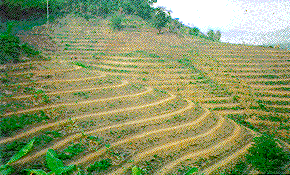
The deterioration of
land resources is increasingly severe mainly from the misuse
and mismanagement of land. Soil erosion at moderate and
extreme levels are commonly found which result in
the accumulation of sediment and silt in the water resources.
The cultivated land loses its fertility which leads to low
production and low income. Soil and water conservation project
is urgently needed to restore natural resources from further
erosion damages.
|
 |
|
| |
| Objectives: |
|
To demonstrate and provide
information to land users and farmers on how to make the best
use of land and water, as well as how to revitalize the unfertile
soil. |
|
|
|
|
|
| |
| Operation
sites: |
|
Every provinces in the
country |
|
|
|
|
|
| |
| Scope
of work: |
1. |
Demonstration and experimentation
on soil and water conservation for the area of 360,000 rai |
2. |
Arrange to
have an infrastructure for soil and water conservation system,
i.e., terraces, diversions, farm roads, farm ponds, for the
area of 1,500,000 rai. |
3. |
Procurement of 3,400 ton
of seeds for soil and water conservation. |
4. |
Training and extension
on soil and water conservation for 2,256,000 governmental personnel
and farmers. |
|
| |
| Budget
and duration: |
|
5 years (1997-2001) |
|
|
|
6,795.6 million baht |
|
|
|
| |
14. Highland Development Project |
| |
| Royal
Development Project for the hilltribes has been established to help
reducing the damage of northern natural resources. Several semi-temperate
economic plants are introduced to substitute the poppy farms that
were the main income of the hilltribes. The Royal Project is operated
in 5 northern provinces: Chiang Mai, Chiang Rai, Lumphun, Mae Hong
Son, Payao. It also includes 294 villages of 73,425 highland and low
land people. Land Development Department has joined the Royal Project
to develop these resources. |
| |
| Objectives: |
|
To establish soil and
water conservation system as well as proper land use that is
suitable for the specific area, prevention of soil erosion in
the Royal Project area is planned. |
|
|
|
|
|
| |
| Operation
sites: |
|
5 northern provinces:
Chiang Mai, Chiang Rai, Lumphun, Mae Hong Son, Payao. |
|
|
|
|
|
| |
| Scope
of work: |
1. |
Lay out and plan for 25
agriculture development projects on 37,500 rai. |
2. |
Land development
and soil and water conservation system for the area of 37,500
rai. |
3. |
Construction of 96 irrigation
system and 325 km. of farm roads into the project area. |
4. |
Mapping the Royal Project
area for soil and water conservation system using GIS, covering
the area of 5,000 rai. |
5. |
Develop and advocate the
use of vetiver grass in the Royal Development Project area of
37,500 rai. |
6. |
Procurement of 260 ton
of seeds for highland development. |
|
| |
| Budget
and duration: |
|
5 years (1997-2001) |
|
|
|
429.85 million baht |
|
|
|
| |
15. Extension and Public Relation on Land Development Project |
| |
| To
make the farmers well aware of the importance of soil and water conservation,
an positive approach to disseminate information on how to use the
land properly and the return benefit in the long run must be clearly
demonstrated. |
| |
| Objectives: |
|
An effective approach
to disseminate information and the functions of the Land Development
Departmenton soil and water conservation to be widely known
to the public. |
|
|
|
|
|
| |
| Operation
sites: |
|
All over the country |
|
|
|
|
|
| |
| Scope
of work: |
|
Master plan
for positive public relation approach is planned. Implementation
plan is also laid. |
|
Scopes and
procedures of extension and public relation on the following
subjects: |
|
1. |
land use zone,
land misuse and the right approach |
|
2. |
publication in forms of
posters and journals |
|
3. |
model of land remodeling
(paddy field) |
|
4. |
model of land development
village |
|
5. |
dissemination through
local mass media |
|
6. |
broadcasting, radio program,
video tapes, documentary program, newspaper, as well as private
public relations |
|
| |
| Budget
and duration: |
|
5 years (1997-2001) |
|
|
|
248.77 million baht |
|
|
|
| |
16. Land Development Researches Project |
| |
| Research
work in Land Development Department cover the topics on soil and water
conservation, watershed management, soil improvement, soil survey
and analysis, land use planning, socio-economic and evaluation, as
well as research experiment for land development. These projects are
distributed to several development programs and narrowed down to each
specific problem. It is, therefore, more effective and systematic
to put them all under one main topic of "Research for land development"
whereby emphasis will be made on land resource improvement and land
management information of soil types suitable for each location. |
| |
|
| |
| Objectives: |
|
Result of research on
land management could be effectively implemented and reach the
end users. Sustainable agriculture development is emphasized.
Farmers have various alternatives to select according to suitable
soil types. |
|
|
|
|
|
| |
| Operation
sites: |
|
62 groups of soil all
over the country |
|
|
|
|
|
| |
| Scope
of work: |
|
The following
research projects are implemented: |
|
1. |
625 projects
on land development |
|
2. |
230 projects on soil and
water conservation |
| |
3. |
85 projects on watershed
management |
| |
4. |
120 projects on soil improvement |
| |
5. |
145 projects on organic
material and waste |
| |
6. |
165 projects on improvement
of saline soil |
| |
7. |
155 projects on acid and
organic soil improvement |
| |
8. |
270 projects on soil survey,
analysis, land use planning and evaluation |
| |
9. |
100 projects on Royal
Projects |
| |
10. |
120 projects on vetiver
grass research |
| |
|
| |
|
|
|
| |
| The total
of 2,015 projects. |
1. |
Research record and report
are written, as well as report on land management of 62 groups
of soil. |
|
|
|
|
|
| |
| Budget
and duration: |
|
5 years (1997-2001) |
|
|
|
446.7 million baht |
|
|
|
| |
17. Royal Land Development Projects |
| |
| There
are 25 projects operated through Land Development Department.. |
| |
| Objectives: |
|
To have a complete land
development program, increase the farmers' income and their
standard of living in the project area. |
|
The results
of the study, research and experiments are implemented as a
model. |
|
Transfer of agricultural
knowledge and technologies to the farmers. |
|
| |
| Operation
sites: |
|
19 provinces : Prachin
Buri, Petchabun, Buri Rum,Mae Hong Son, Yala, Prachuap Kiri
Khan, Chachoengsao, Rayong, Chon buri, Nakhon Ratchasima, Ratchaburi,
Chanthaburi, Narathiwat, Lumphun, Chiang Mai, Trad, Chiang Rai,
Tak, Nakhon Sri Thammarat. |
|
|
|
|
|
| |
| Scope
of work: |
|
Follow the
plan procedures and maintain the Royal Land Development project
area by: |
|
1. |
Make a survey,
classify, and land use plan for the area of 164,475 rai and
start a new land development area of 15,450 rai. |
|
2. |
Demonstrate and promote
soil revitalization in the area of 50,800 rai and produce 31,500
tons of decomposed fertilizer. |
| |
3. |
Establish soil and water
conservation system for the area of 85,400 rai. |
| |
4. |
Train 35,990 farmers. |
| |
5. |
Maintain the project area
of 100,000 rai. |
|
| |
| Transfer the
results of the research experiments to the Budget and duration: |
|
5 years (1997-2001) |
|
|
|
647.32 million baht |
|
|
|
| |
18. Eastern Soil and Water Conservation Center Project |
| |
| In
1983, Land Development Department received a funding support from
FAO and later on having a joint project from Japan (JICA) to alleviate
the problem of Eastern soil erosion. It is, therefore, necessary to
lay a clear and concise plan on soil and water conservation specifically
for eastern land area. The plan has to be feasible and acceptable
to use by the farmers. Training and transferring of technologies on
soil and water conservation to the government personnel and eastern
farmers are included. |
| |
| Objectives: |
|
To find an appropriate
procedure to conserve soil and water using a pilot project together
with the analysis of research data. |
|
To be the center of soil
and water conservation whereby training and transferring of
technologies on soil and water conservation to government personnel
and farmers are provided. |
|
|
|
| |
| Operation
sites: |
|
At the following eastern
provinces: Chon Buri, Chachoengsao, Rayong, Chanthaburi, Prachin
Buri, Sa Kaeo, Trad. |
|
|
|
|
|
| |
| Scope
of work: |
|
Phase 1: 1992-1998 |
|
|
Pilot projects
are established in 16 locations. Researches on soil moisture,
soil tillage, and farm management are done. |
| |
Phase 2: 1999
onwards |
|
|
Expansion and continuation
of the projects in phase1. |
|
| |
| Budget
and duration: |
|
5 years (1997-2001) |
|
|
|
108.98 million baht |
|
|
|
| |
| |
|