|
|
|
| |
|
"Vetiver Grass"
Natural - Structured
Engineering
|
| |
|
|
|
|
|
Hardly
can anyone deny that nature has created everything proportionately
but to exist eternally depends on how human beings make use of the
nature and how they apply technology and knowledge to use
with it inappropriately.Nowadays nature has sent warning signals
periodically such as increasing temperature of the earth, green
house effect, including various forms of natural phenomena. |
| This
crisis makes people all over the world turn their attention to use
nature to cure itself because there isn't any side effect
resulting from using natural equilibrium. For Thailand, the
urgent problem to be solved is soil, an important factor in every
life existence, of which the deterioration starts to be continually
severe because of in appropriate using soil resources . Deforestation
causes soil erosion, resulting in low crop yields and agriculturalists
having harsh life. |
|
|
|
Vetiver
Grass, an auspicious plant in agriculture, is another
way of using nature to take care itself.The King of Thailand has
paved the way to have it studied and experimented for soil and water
conservation since 1991. This is due to the fact that it has a special
quality which benefits soil and water conservation in many ways
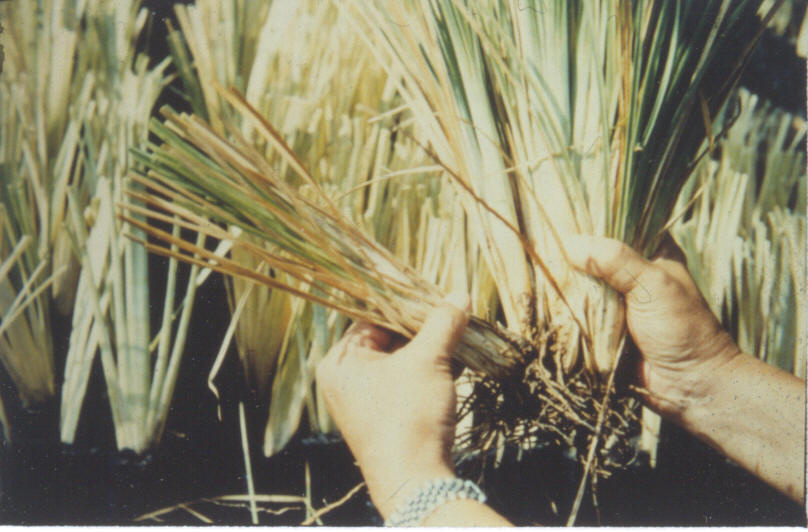
such as preventing soil erosion because it has deep-rooted fibrous
roots with good anchorage as if it is an engineering structure created
by nature. It can also absorb moisture in the soil, grow
in bad soil, skeleton soil and can resist flooding for a long
period of time. |
| |
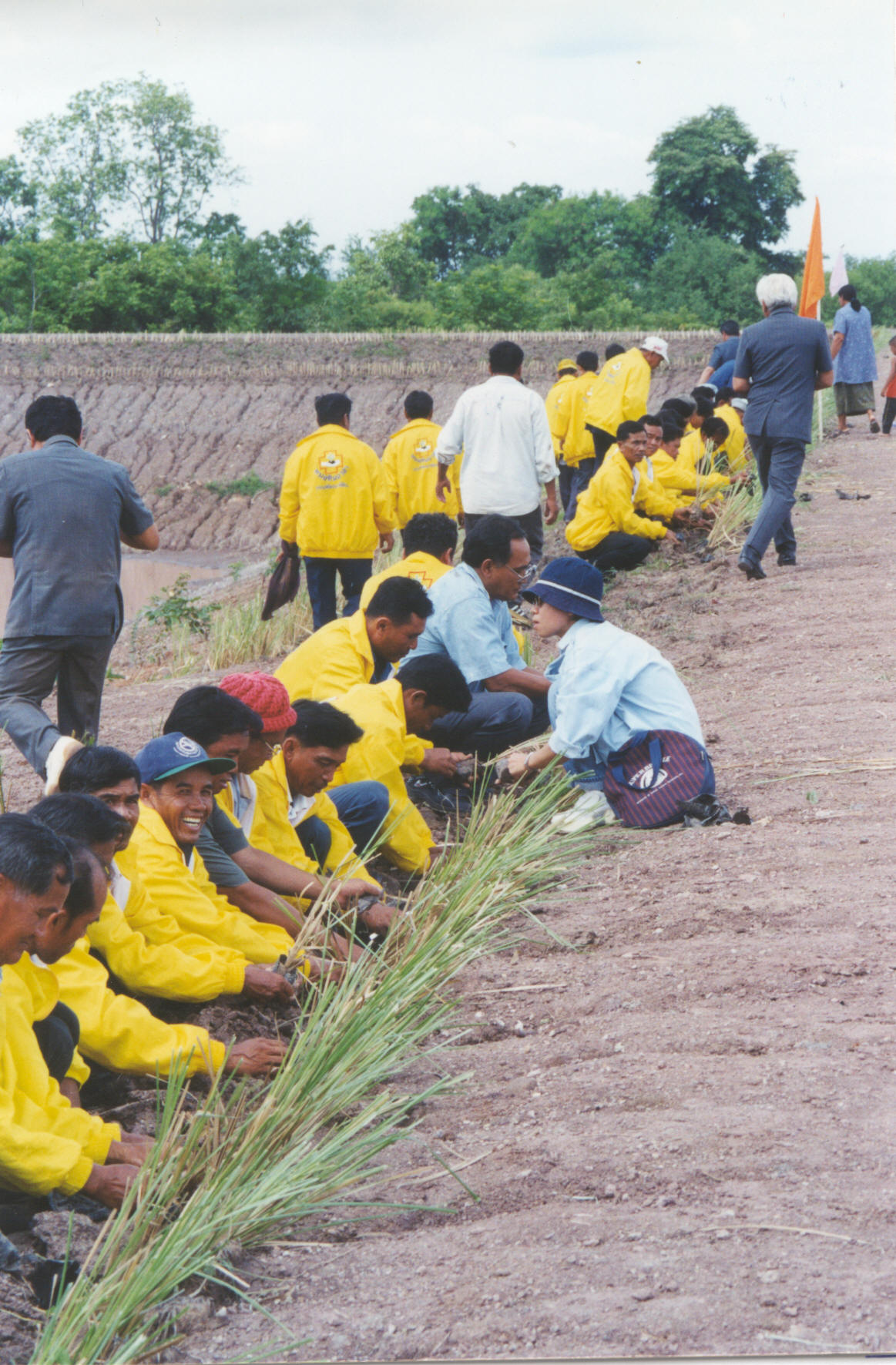
It
also helps keeping soil or building it up because the recommended
way of doing is to plant it continuously in rows. If the plant dies,
replacement must be done in order to avoid space created. The line
of Vetiver Grass helps reducing the speed of water while sediments,
remnants of leaves and plant will remain along the line of Vetiver
Grass and become soil later on. Vetiver Grass also helps prolonging
construction such as roads, dams, irrigation canals…etc., because
it helps preventing soil in front of dams, above dams for irrigation
purpose from eroding and also helps minimizing damages from sediments
deposited. |
| Up
to now the Land Development Department,Ministry of Agriculture and
Co-operative of Thailand,has done researches and experiments in
order to find ways to benefit from Vetiver Grass for more than 8
years in terms of technique of reproduction, planting, including
making use of Vetiver Grass in the aspects of
agriculture, of reducing the impact on the environment and
of producing products from it. This makes agriculturists all over
accept the fact that growing Vetiver Grass is the easiest, most
suitable and economical way to prevent soil from eroding. |
|
|
|
|
|
| |
| |
 |
The results form above-mentioned
researches can be summarized as follows: |
|
| |
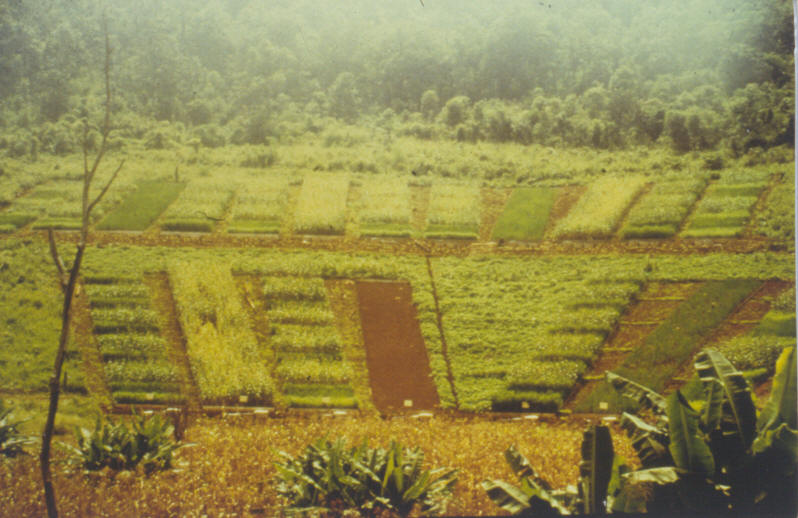
(1)
Among 78 domestic, foreign and the King-given breeds, 28 breeds
has been selected out of them. Each breed is suitable to grow in
different soils and environments all over Thailand. Among
them , the Department also studies and selects the breeds
that grow in areas all over Thailand that have problems with such
as sandy, skeleton soil etc., It has found that there
are 10 groups that are suitable - 6 breeds
of Vetiver Grass grown in highland which are Kamphang
Petch 1.Loei, Nakorn Sawan, Prajuab Kirikhan, Ratchburi and Roi
Et and 4 breeds of Vetiver Grass grown in lowland which are Kamphang
Petch 2, Songkhla 3, Sri Lanka and Surat Thani. |
|
| |
(2)
The findings from studying ways to propagate Vetiver Grass indicate
that Vetiver Grass can be propagated by roots, stems, tissue cultures
and suitable planting. The study has resulted in reproduction
of 200 million seedlings for the past year. The land Development
Department can be counted as number one in having the most Vetiver
Grass in the world. Moreover, the Department has distributed
them to agriculturalists, interested public and given them advice
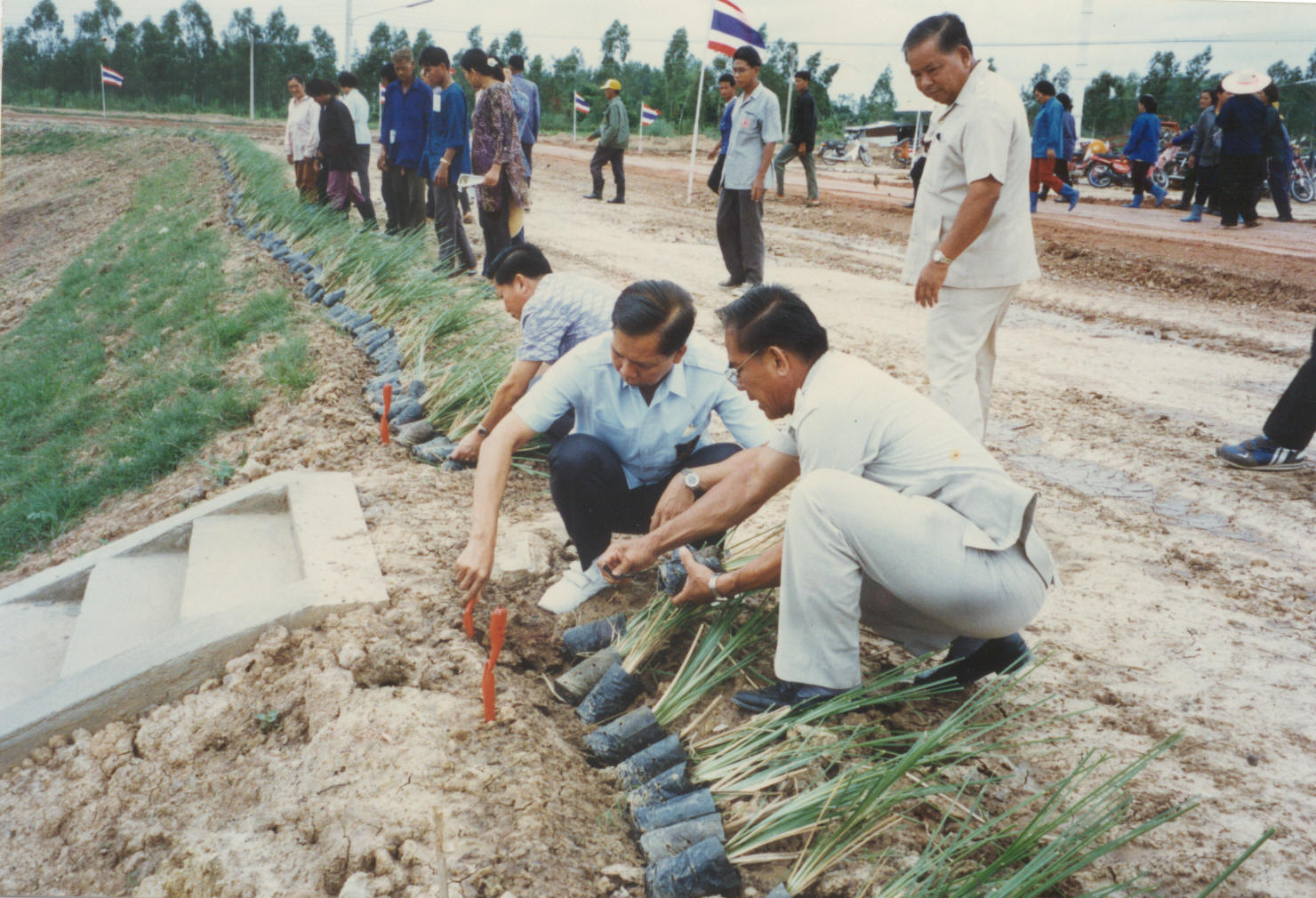
how to grow them properly. Vetiver Grass must be grown
in rows along its level line with the distance between each one
of 5 - 10 cm according to the suitability
of the soil. For the distance between the rows. The
vertical difference should be about 1 - 3 meters,
depending on the slopes and types of plants that will be grown.
The best time to grow should be during the rainy season of June
to August. |
|
| |
(3)
From the study of the effect of Vetiver Grass
on soil erosion indicated that planting Vetiver Grass
can prevent soil from eroding. The beds in which
Vetiver is grown helped the soil from eroding away or
if any erosion occurs, it will not exceed 200 kg/rai per year (1
acre = 2.52 rai) . Vetiver Grass can be grown in any slope
- agriculture area, watercourse, hillside, pond
edge, or reservoir edge. |
|
| |
|
Another
significant finding is that Vetiver Grass can loosen the soil, help
the soil in having good structure and obviously help increasing
the amount of useful organisms in the soil. Vetiver can be
beneficial in other ways: its leaves can be used to cover soil
in order to keep moisture in the soil and can be used
as roofs; it can be mixed
with soil and cement for using as construction materials; it can
be mixed with polymer for using as equipment and furniture;
its roots can be extracted for oil and perfume. |
|
| |
|
The
result of devotion, study and researches contributed
to the success of the Land Development Department in receiving "
The King of Thailand Vetiver awards" ( Research on Methodologies
for Selection, Propagation and Cultivation Techniques of Vetiver
Grass and Its Application in Thailand). This is
considered an outstanding work which brings fame and confidence
to the public who receive the service. |
|
|
|
|
Vetiver Grass is considered
another conclusion chapter that letting
|
|
nature take care itself creates
the equilibrium of inter-dependence of everything.
|
| |
|
For more information
|
|
Please contact
|
|
Land Development Region
|
|
Land Development Station
|
|
Public Relations Sub-division, Office
of the Secretary
|
|
Land Development Department, Phaholyothin
Road, Chatuchak, Bangkok 10900 Thailand Tel. 0-2579-8515
|
|
E-mail : ofs_5@ldd.go.th or egd_1@ldd.go.th
|
|
Volunteer Soil Doctors
|
|
|
|
Land
Development Department
|
|
2003
/ 61 Phaholyothin Rd. Chatuchak Bangkok
10900 Thailand
|
|
Call
: 66 - 2579 - 4132 - 40 or 66 - 2941
2131 www.ldd.go.th or
www.gisservice.net
|
|
Copyright
2002 Land Development
Department
|
|
|
| |